BIP39 Mnemonic & Entropy Studio
Generate 12–24 word mnemonics via WebCrypto, verify SHA-256 checksums, and inspect 11-bit indices.
SHA-256 / SHA-512 Hasher
Compute cryptographic SHA-256 and SHA-512 digests locally in browser RAM.
Passphrase & Key Generator
Generate high-entropy Diceware passphrases and random passwords via CSPRNG.
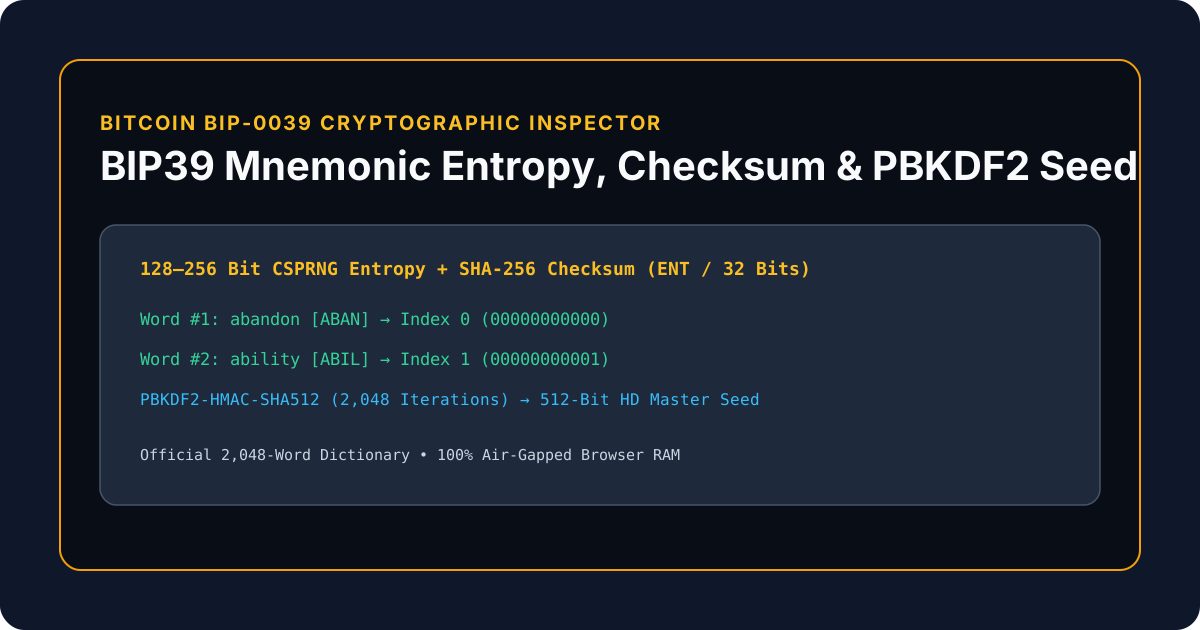
Inside BIP-0039: How Raw Cryptographic Entropy Becomes Human-Readable Words
Introduced in 2013, Bitcoin Improvement Proposal 39 (BIP-0039) standardized how deterministic wallets encode raw 128-bit to 256-bit cryptographic keys into memorable 12- to 24-word sequences.
In the KitWharf BIP39 Mnemonic Seed Phrase & Entropy Inspector, you can inspect every step of the bitwise pipeline 100% locally in your browser's WebCrypto RAM sandbox:
Word Count (MS) |
Raw Entropy (ENT) |
SHA-256 Checksum (CS = ENT/32) |
Total Bits (ENT + CS) |
11-Bit Word Chunks |
|---|---|---|---|---|
| 12 Words | 128 bits (16 bytes) |
4 bits |
132 bits |
12 × 11 bits |
| 15 Words | 160 bits (20 bytes) |
5 bits |
165 bits |
15 × 11 bits |
| 18 Words | 192 bits (24 bytes) |
6 bits |
198 bits |
18 × 11 bits |
| 21 Words | 224 bits (28 bytes) |
7 bits |
231 bits |
21 × 11 bits |
| 24 Words | 256 bits (32 bytes) |
8 bits |
264 bits |
24 × 11 bits |
Step-by-Step Bitwise Walkthrough: From CSPRNG Bytes to 11-Bit Word Indices
To understand why BIP-0039 recovery phrases are both human-friendly and cryptographically verifiable, trace what happens inside Tab 1 and Tab 2 of the KitWharf BIP39 Mnemonic & Entropy Inspector:
1. Hardware CSPRNG Entropy Generation (ENT)
For a standard 12-word phrase, the browser invokes window.crypto.getRandomValues(new Uint8Array(16)) to draw 128 bits (16 bytes) of cryptographic randomness from your operating system's entropy pool.
- Suppose all 16 bytes are zero (
00000000000000000000000000000000in hex, the canonical BIP-0039 test vector).
2. SHA-256 Checksum Calculation (CS = ENT / 32)
Next, the raw 16-byte buffer is hashed with SHA-256 via crypto.subtle.digest("SHA-256", entropyBytes):
- For 16 zero bytes, the SHA-256 digest begins with hex byte
0x37= binary00110111.... - Because
CS = 128 / 32 = 4 bits, we take the first 4 bits of the SHA-256 hash:0011. - Appending those 4 checksum bits to the 128 zero bits produces a 132-bit string where the first 121 bits are
0and the final 11 bits are00000000011.
3. Splitting into 11-Bit Chunks (0–2047)
Because 2^11 = 2,048, every 11-bit slice maps 1-to-1 onto a word in the official 2,048-word BIP-0039 English dictionary:
- Words 1 through 11:
00000000000(Decimal Index0) →abandon - Word 12:
00000000011(Decimal Index3) →about - Resulting Test Vector Phrase:
abandon abandon abandon abandon abandon abandon abandon abandon abandon abandon abandon about.
If you change the last word from about (index 3, trailing bits 0011) to ability (index 1, trailing bits 0001) in Tab 2 (Checksum & Phrase Validator), the auditor immediately alerts you: Invalid SHA-256 checksum: expected 0011 but trailing word encodes 0001!
How PBKDF2-HMAC-SHA512 Derives the 512-Bit HD Master Seed
Surprisingly, BIP-32 hierarchical deterministic wallets do not use the 128-bit or 256-bit entropy buffer directly to derive private keys. Instead, BIP-0039 passes the space-separated English mnemonic sentence through PBKDF2 key stretching:
- PRF (Pseudorandom Function):
HMAC-SHA512 - Password Input: UTF-8 NFKD-normalized mnemonic sentence (e.g.,
"abandon abandon ... about") - Salt Input: UTF-8 NFKD-normalized string
"mnemonic" + passphrase - Iteration Count:
2,048 rounds - Output Length:
512 bits (64 bytes / 128 hex characters)
Those 512 bits are then split in half: the left 256 bits become the BIP-32 Master Private Key, and the right 256 bits become the Master Chain Code.
The 4-Letter Steel Backup Property (Tab 3 Dictionary Explorer)
When stamping a recovery phrase onto fireproof stainless-steel or titanium plates (such as Cryptosteel or Billfodl), you only need to stamp the first 4 letters of each word:
- The BIP-0039 English wordlist was curated so that no two words share the same first 4 characters (e.g.,
[ABAN]uniquely identifiesabandon, and[ABOU]uniquely identifiesabout). - Furthermore, visually similar word pairs were deliberately excluded from the dictionary to prevent transcription errors under poor lighting.