Startup Runway & SaaS Studio
Model 24-month cash runway, Default Alive status, LTV:CAC, Rule of 40, and CAGR.
Margin & Markup Calculator
Calculate gross margin, markup %, break-even volume, and freelance day rates.
Invoice & Receipt Maker
Generate clean PDF client invoices directly in your browser with zero signup.
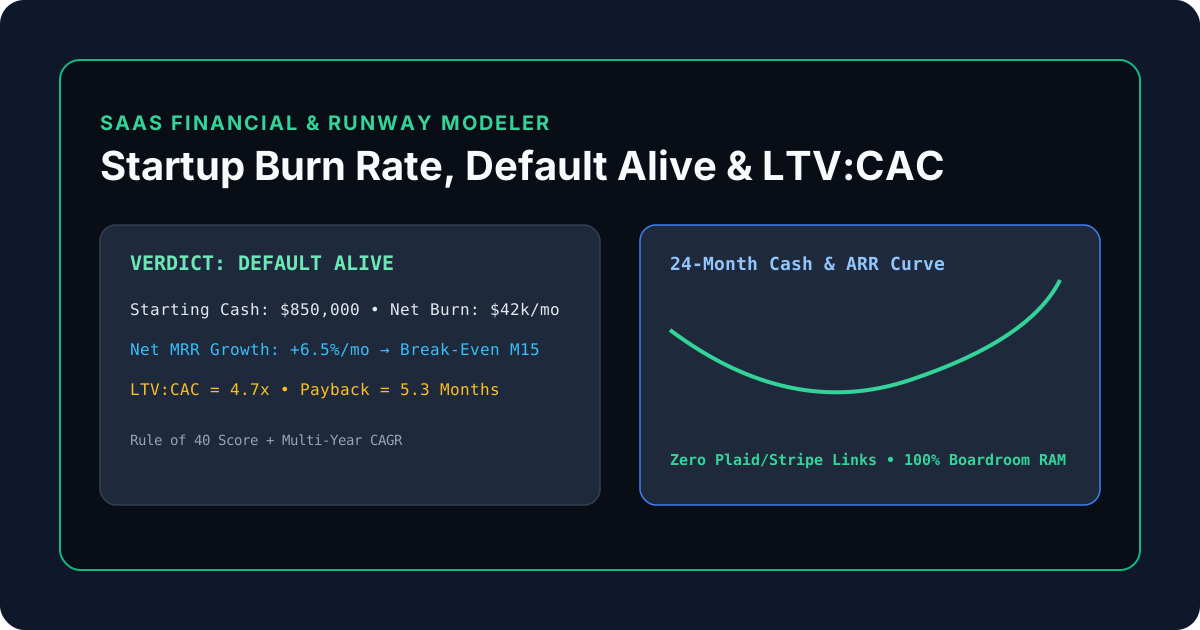
Static Runway vs. Dynamic Compounding Runway: Are You Default Alive?
Founders frequently compute cash runway using the back-of-the-napkin formula: Runway = Cash Balance / Current Net Burn. While useful when revenue is flat, static division ignores the compounding race between Net MRR Growth and Monthly Expense Scaling.
The KitWharf SaaS & Startup Burn Rate, Runway & MRR/CAGR Calculator simulates 24 months of compounding cashflows in browser RAM—telling you immediately whether your startup is Default Alive (reaches break-even before cash hits $0) or Default Dead.
| SaaS Metric | Formula | Healthy Seed / Series A Target |
|---|---|---|
| Net Burn Rate | Gross Monthly Spend - Monthly Recurring Revenue (MRR) |
Shrinking month-over-month |
| Customer LTV | (Monthly ARPU × Gross Margin %) / Monthly Revenue Churn % |
> 3× CAC |
| CAC Payback Period | CAC / (Monthly ARPU × Gross Margin %) |
< 12 Months (< 6m for PLG) |
| SaaS Rule of 40 | YoY ARR Growth Rate (%) + Free Cash Flow Margin (%) |
≥ 40% |
| Multi-Year CAGR | (Ending Value / Beginning Value)^(1 / Years) - 1 |
> 80%–100% early stage |
Deep Dive: Paul Graham's "Default Alive vs. Default Dead" Trajectory Math
In his classic Y Combinator essay Default Alive or Default Dead?, Paul Graham observed that the single most important question a founder must answer is: "Assuming our expenses stay on their current trajectory and our revenue continues growing at its current monthly rate, do we reach profitability before we run out of money?"
Why do so many founders miscalculate this? Because they confuse Static Runway with Compounding Runway:
Worked Scenario: Seed SaaS Startup with $850,000 in the Bank
Suppose your startup has:
- Starting Cash Balance:
$850,000 - Monthly Gross Burn:
$70,000/mo($48kpayroll +$9.5kcloud infra +$12.5kmarketing) with1%/moexpense creep - Starting MRR:
$28,000/mo($336,000 ARR) - Gross Monthly MRR Growth:
8.5%/mo - Monthly Revenue Churn:
2.0%/mo(Net MRR Growth =+6.5%/mo)
- The Naive Static Calculation:
In Month 1, Net Burn is
$70,000 - $28,000 = $42,000/mo. Dividing$850,000 / $42,000suggests you will run out of money in 20.2 months. - The Dynamic Compounding Reality (Tab 1 & Tab 2):
Because your MRR compounds at
+6.5%/monet of churn, your monthly revenue grows from$28,000in Month 1 to$55,976in Month 12 ($671k ARR) and surpasses your Gross Burn in Month 17 ($76,680 MRRvs.$75,076 Gross Burn)!- Cumulative cash burned through Month 16 is only
$378,400, leaving a safety buffer of$471,600in the bank at break-even. - Verdict: DEFAULT ALIVE (∞ Self-Sustaining Runway).
- Cumulative cash burned through Month 16 is only
Conversely, if Net MRR Growth drops to +1.5%/mo while Gross Burn climbs to $95,000/mo, the 24-month simulator immediately flags DEFAULT DEAD and pinpoints the exact month your bank balance crosses $0, giving you 6–9 months of advance lead time to cut burn or raise a bridge round.
Mastering SaaS Unit Economics: LTV:CAC, Payback Months & The Rule of 40
Before raising a Seed or Series A round—or scaling paid acquisition—switch to Tab 3 (LTV:CAC, Rule of 40 & CAGR) in the Startup Runway Calculator to audit your unit economics:
- Gross-Margin-Adjusted LTV:
Never compute Customer Lifetime Value using raw top-line ARPU. If a customer pays
$149/mo, your cloud hosting and support cost 18% (82% Gross Margin), and monthly revenue churn is2.0%, your true gross-margin LTV is:LTV = ($149 × 0.82) / 0.02 = $6,109. - LTV:CAC & Payback Period:
With a Customer Acquisition Cost (
CAC) of$650, your LTV:CAC Ratio is$6,109 / $650 = 9.4x, and your CAC Payback Period is$650 / ($149 × 0.82) = 5.3 Months. That means every dollar spent on sales and marketing returns to your bank account in just over five months. - The Rule of 40 Benchmark:
At scale, public and late-stage SaaS investors sum your Annualized ARR Growth Rate (%) and your EBITDA / Free Cash Flow Margin (%). A startup growing ARR at
75% YoYwith a-25%burn margin achieves a Rule of 40 Score of50%(75% + (-25%) = 50% ≥ 40%).